Low Cost OCR for Startups: A Pragmatic Guide to Zero-Bloat Document Processing
A pragmatic guide to low cost OCR for startups: pay-as-you-go pricing, verifiable bounding boxes, and lean CLI and API workflows without enterprise bloat.
The most expensive document pipeline isn't the one with the highest price per page. It's the one that forces you to pay for seats you'll never use. Most founders start with "free" tiers only to hit scaling walls, while others get trapped in enterprise contracts that ignore their actual usage. Finding low cost OCR for startups requires moving past the marketing fluff and focusing on raw utility. You're likely tired of fixing hallucinated data points and managing unpredictable API billing that spikes without warning.
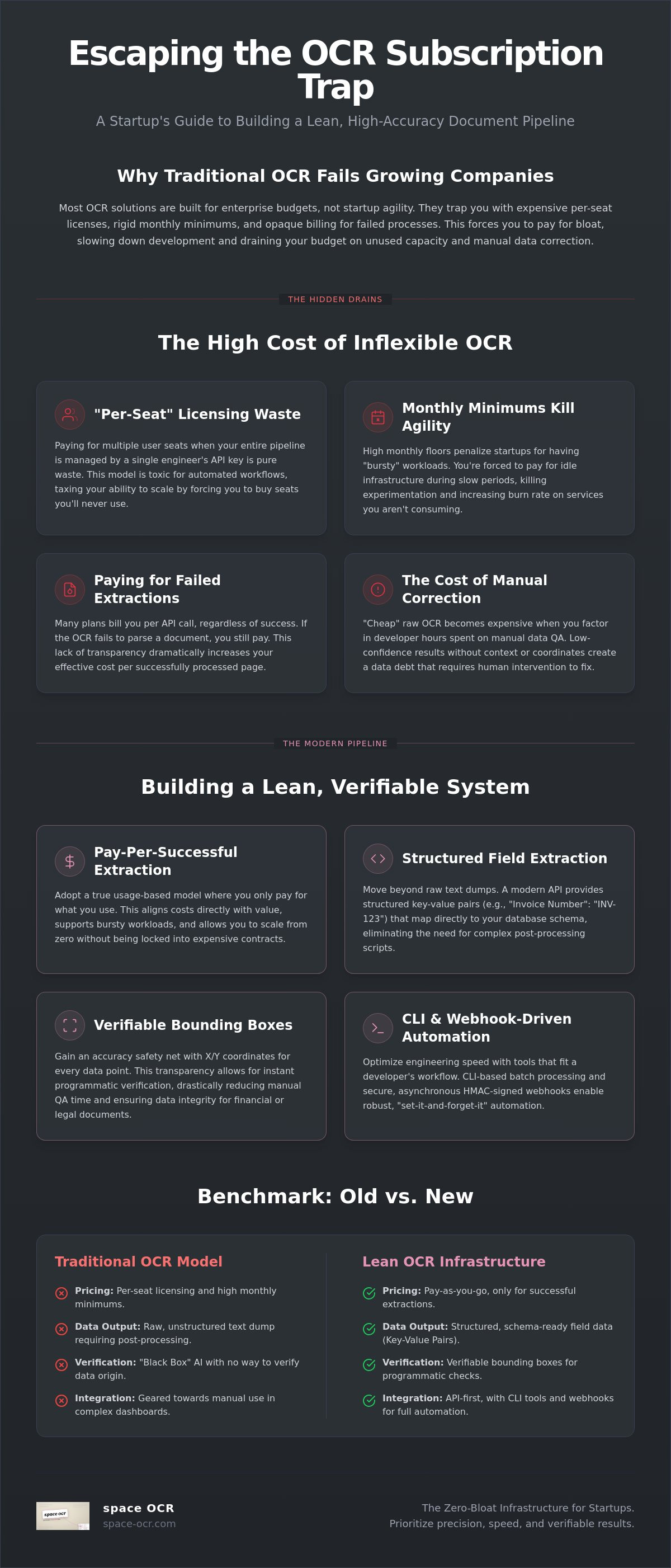
Your engineering time is too valuable to waste on manual verification or brittle integrations. You need a system that respects your budget and your data integrity. This guide shows you how to build a scalable document pipeline without the burden of enterprise subscriptions. We will break down the mechanics of pay-as-you-go pricing, verifiable data via bounding boxes, and CLI-based workflows that plug into your developer environment. It's time to stop paying for bloat and start building a pipeline that prioritizes precision and verifiable results.
Key Takeaways
- Identify and eliminate the hidden drains of "per-seat" licensing and monthly minimums that inflate document processing budgets.
- Distinguish between raw text extraction and structured field data to ensure your database receives only validated, high-integrity information.
- Implement low cost OCR for startups by adopting a usage-based model where you only pay for successful extractions.
- Improve engineering speed through CLI-based workflows and secure, asynchronous automation using HMAC-signed webhooks.
- Reduce manual QA time by using bounding boxes to verify data coordinates directly against source documents.
Table of Contents
- Beyond the Subscription Trap: Why Startups Overpay for OCR
- Benchmarking Low-Cost OCR: Accuracy, Speed, and Verifiability
- Decoding OCR Pricing Models for 2026
- Building a Lean Document Pipeline: Integration Strategies
- space-ocr: The Zero-Bloat Infrastructure for Startups
Beyond the Subscription Trap: Why Startups Overpay for OCR
Startups often mistake enterprise-grade features for operational efficiency. Most traditional vendors build their pricing around predictable corporate budgets, not the volatile growth cycles of a new company. This misalignment creates a subscription trap where you pay for potential rather than performance. Finding a low cost OCR for startups isn't about chasing the lowest headline price; it's about avoiding the architectural bloat that forces you to pay for idle infrastructure. You shouldn't have to subsidize a vendor's sales team through inflated monthly minimums.
The "per-seat" licensing model is particularly toxic for technical document workflows. If your pipeline is managed by a single engineer through an Optical Character Recognition (OCR) API, paying for five or ten mandatory user seats is pure waste. These seats are often a prerequisite for accessing higher-tier features, such as batch processing and webhooks, effectively taxing your ability to scale. This model ignores the reality of modern automation where the value lies in the data throughput, not the number of people logged into a dashboard.
Monthly minimums present a similar hurdle. They kill experimentation and pivot speed. If you're testing a new feature that requires document parsing, you shouldn't be penalized with a high monthly floor before you've even validated your product-market fit. This "bursty workload" problem is the reality for most early-stage teams. You need a system that stays dormant during slow months and scales instantly when a marketing campaign or seasonal spike hits. Without this flexibility, your burn rate increases for services you aren't even consuming.
The Problem with Flat-Rate Monthly Subscriptions
Flat-rate plans offer the illusion of predictability while hiding rigid scaling constraints. These plans often force teams into higher tiers prematurely because they hit a single feature gate, such as a file size limit or a specific export format. There is also a distinct lack of transparency regarding "successful" versus "failed" extractions. If an API call fails to parse a document but you're still billed for the request, your effective cost per page climbs. This creates unnecessary friction in procurement for tools that should be simple, plug-and-play solutions like the space-ocr web app.
Total Cost of Ownership (TCO) in Document AI
True cost isn't just the API bill. It involves the developer hours spent on integration and the price of manual data correction. When an OCR engine returns low-confidence data without coordinates, your team spends hours on manual QA. Using a Structured Field OCR API that provides verifiable bounding boxes reduces this downstream data cleaning. "Cheap" raw OCR often becomes expensive when you realize you've inherited a data debt that requires a secondary AI layer or human intervention to fix. Implementing low cost OCR for startups means choosing tools that offer structured, verifiable output from the very first call.
Benchmarking Low-Cost OCR: Accuracy, Speed, and Verifiability
Accuracy is a variable, not a constant. For a developer building a database-driven application, raw text strings are often a liability. You need structured fields — key-value pairs that map directly to your schema. This is the point where low cost OCR for startups often fails. Basic engines dump text without context, forcing your team to write complex regex or post-processing scripts to make the data usable. If your database requires an "Invoice Number" and a "Total Amount," a simple text stream isn't enough. You need an engine that understands document structure.
Latency matters for the next benchmark. Real-time, user-facing applications can't afford a long processing delay when a user is waiting on a result. Global-first startups must also consider multi-language support. An engine that performs well on English-only documents may fail when processing Japanese, Korean, Chinese, or other scripts, leading to silent data corruption in your pipeline. space-ocr detects the document language automatically — one engine handles Japanese, Korean, Chinese, and English text without a language parameter or selector — so linguistic breadth doesn't cost you a separate integration.
Verifiable Bounding Boxes: The Accuracy Safety Net
A bounding box locates every extracted value on the page. space-ocr returns four integers — xmin, ymin, xmax, ymax — on a 0–1000 normalized grid, where (0,0) is the top-left corner and (1000,1000) is the bottom-right. To draw a box over a rendered image you scale it back to pixels, for example pixel_x = xmin / 1000 * image_width, where image_width is data.image.width — the size of the page as it was actually read, which is not always the size of the file you sent. Each entry in data.cells carries its evidence next to the coordinates, including an evidence.match_ratio: the share of that value's characters that were actually located among the page's OCR-detected symbols, not a model self-confidence score. The review queue is a separate, explicit surface. data.review.flagged is a list of { path, reasons } covering the values the engine could not settle, the same reasons sit on the cell under cells[path].review.reasons (ranked, with index 0 as the primary one: text_mismatch, low_ratio, missing, and so on), and cells[path].verified mirrors that verdict — false when something was flagged, true when a check ran and nothing came up, null when there was nothing to cross-check. Instead of trusting a "black box," your system gets evidence for where each value came from. By reviewing IBM's explanation of OCR, you can see how fundamental spatial recognition is to data integrity. Human-in-the-loop (HITL) review then goes to the fields on flagged and nothing else — flagged.length is the size of that queue — which cuts manual QA overhead.
Infrastructure Comparison: Cloud Giants vs. Specialized APIs
Cloud providers like AWS and Google publish low headline rates for basic text detection, and those rates move, so check each vendor's current pricing page before you model your costs. The implementation complexity for structured data is the real difference. You're responsible for building the parsing logic on top of their raw output. On the other end, enterprise platforms provide structured output but demand prohibitive monthly minimums. Specialized tools like the Structured Field OCR API offer a middle ground. They provide structured extraction with the pay-as-you-go flexibility that startups require. This lets you scale your low cost OCR for startups strategy without sacrificing data precision or developer time.
Decoding OCR Pricing Models for 2026
Pricing strategies for 2026 have shifted away from opaque tiers toward granular, event-driven billing. For a builder, the most effective low cost OCR for startups is one that eliminates the "failure tax." You shouldn't pay for documents that return an error or fail to produce a usable result. A model like $0.05 per image, billed only on success, ties your burn rate directly to your product's actual utility rather than your vendor's server overhead. It's a pragmatic approach to infrastructure that respects your runway.
Real-time synchronous calls are useful for user-facing validation, but they shouldn't be your only option. Batch processing with webhooks lets you offload non-critical extractions to an asynchronous queue: you submit a batch, the engine works through it, and your endpoint receives an ocr.completed event when each result is ready. This reduces the pressure on your infrastructure. Rapid prototyping also benefits from a no-credit-card free tier — space-ocr includes 100 free scans every month — so your team can test edge cases and verify schema compatibility before committing a single dollar to production. You verify the tool's behaviour before it touches your billing cycle.
What is Pay-As-You-Go OCR?
This model ties billing strictly to successful extraction events. It aligns incentives between you and the provider. If the engine fails to parse a complex table or a blurry scan, you don't pay — failed scans are never charged, and a synchronous call that runs past the 180-second processing ceiling isn't charged either. Forecasting spend becomes a simple function of your user growth. If you know your average document count per user, you can project your OCR costs closely. You avoid the sudden "tier-up" shocks common in subscription models that demand more money the moment you cross a page threshold.
The Myth of the "Unlimited" OCR Plan
"Unlimited" is a marketing term, not a technical reality. These plans usually hide aggressive throttling or "fair use" policies that cap your throughput just when you need it most. They also often lack the granular audit trails required for serious data architecture. A transparent, per-image record gives you the verifiable evidence you need for compliance and debugging. You can see exactly what was processed and the coordinates (bounding boxes) that anchor each value to its place on the page. That level of detail is missing from flat-rate plans that treat your data as a black box. Transparency is what keeps low cost OCR for startups reliable at scale.
Building a Lean Document Pipeline: Integration Strategies
Choosing the right interface defines your operational velocity. While a REST API is the backbone of production systems, a low cost OCR for startups strategy should also include CLI and web app access for different stakeholders. Developers want terminal-based tools for rapid testing and local automation; operations teams want a GUI to manage exceptions and verify edge cases. Moving from manual entry to automated parsing requires a pipeline that handles these distinct workflows without adding architectural overhead.
Security can't be an afterthought in automated pipelines. HMAC-signed webhooks ensure that your ingestion endpoint only processes verified payloads from your provider — space-ocr signs every delivery with an X-Spaceocr-Signature header (HMAC-SHA256). This prevents spoofing and protects data integrity as you scale. Asynchronous processing through webhooks lets your application stay responsive while the OCR engine handles the heavy lifting in the background. You listen for the ocr.completed event, verify the signature, and ingest the structured data into your database. It's a clean, decoupled architecture that minimizes server-side waiting. Two operational limits shape how you retry: a single key is capped at 60 requests a minute and anything past that returns HTTP 429, and an Idempotency-Key header makes a repeat of the same request within 24 hours replay the cached response instead of paying for a second scan — a retry safeguard, not a storage mechanism.
Organizing documents in "Spaces" in the space-ocr web app supports team collaboration and orderly data retention. You can group documents by project, client, or type, making it easier to audit extractions before export. In the app you find any value with keyword search across your sheets and move around the grid with the keyboard; for programmatic access, the GET /view API runs server-side where, sort, and select filters over a stored sheet without re-running OCR or incurring charges. Non-technical team members can review values and bounding boxes to confirm the engine mapped fields correctly. Once verified, you export to CSV to populate your internal systems.
Step-by-Step: Integrating OCR into Your CLI
You can bring extraction into your terminal with the space-ocr plugin for Claude Code — a two-line install: /plugin marketplace add oisidonut/claude-space-ocr-skill then /plugin install space-ocr@space-ocr. It talks to the space-ocr REST API through a dependency-free Python client — no pip install, no SDK. If your team already runs an MCP client instead, the same API is reachable at https://mcp.space-ocr.com/mcp; in Claude Code that is claude mcp add --transport http space-ocr https://mcp.space-ocr.com/mcp --header "Authorization: Bearer YOUR_API_KEY", and there is nothing to install either way. From there you can turn a document image (invoice, receipt, business card, ID, form) into structured JSON that maps to your schema, or query documents you've already scanned, without leaving your development environment. It removes the context-switching that usually slows down early-stage development cycles.
Handling Messy Data: Receipts, Invoices, and Handwriting
Extraction from low-quality faxes or handwritten notes benefits from consistent normalization, and space-ocr keeps the two jobs apart instead of asking the model to do both. data.values holds the reading as it is printed — commas, decimals, and full-width characters stay as they appear on the page. Declaring type: "date", "number" or "integer" on a field adds a second layer, data.normalized, shaped exactly like values but with those leaves parsed by a deterministic parser; the declared type is never sent to the model, so it changes what you get back rather than how the page is read. Show values to a person, feed normalized to your arithmetic and your database columns. A leaf that will not parse comes back null there, with the reason in cells[path].normalized.error, and the field lands on review.flagged with type_mismatch — an unreadable date becomes work to check instead of a quietly wrong row. The same declarations replace validation code you would otherwise write and maintain yourself: required raises missing when a field comes back empty, pattern and enum raise pattern_mismatch when a value doesn't fit the shape or the vocabulary your business already owns, and min / max raise out_of_range against the parsed number. This keeps your low cost OCR for startups pipeline a reliable source of truth regardless of document quality. Note that the engine and API take raster images (JPEG, PNG, GIF, BMP, TIFF, WebP); when you drop a multi-page PDF into the web app, it rasterizes each page to PNG before running OCR.
Start building your automated workflow today by integrating the Structured Field OCR API into your stack.
space-ocr: The Zero-Bloat Infrastructure for Startups
space-ocr prioritizes raw utility over the bloated features favored by VC-funded platforms. For founders, the search for low cost OCR for startups ends when you stop paying for failed requests. The $0.05-per-image model means your capital is spent on data you can actually use. If the engine doesn't return a valid result, your balance stays untouched. That alignment of incentives is the foundation of a zero-bloat infrastructure built for people who value precision over marketing promises.
Precision is non-negotiable in production. space-ocr returns bounding boxes for every extracted field, so your system has evidence for where each value came from rather than a bare string. The OCR pass is the only source of those coordinates and the multimodal model that reads the values never produces them: the engine matches each extracted value character-by-character against the page's actual OCR symbols and scores it with a match_ratio, so a value that doesn't line up with the page is surfaced on review.flagged instead of passing quietly. With automatic language detection across Japanese, Korean, Chinese, and English in one engine, your pipeline scales with your global ambitions — linguistic breadth without an enterprise contract. The developer-first surface includes the space-ocr plugin for Claude Code and complete Structured Field OCR API documentation, so you spend less time reading and more time shipping.
Why space-ocr Wins for Early-Stage Teams
Early-stage teams need to move fast without getting bogged down in procurement. There are no per-seat licenses or hidden platform fees to slow your pivot speed. In the app you find any extracted value with keyword search across your sheets; for programmatic access, the GET /view API runs server-side where, sort, and select filters over your stored data. For those dealing with legacy data, asynchronous /upload plus webhooks lets you clear document backlogs without holding a request open. It's infrastructure that grows only when your usage does. You don't pay for idle capacity or unused seats; you pay for the data that powers your application.
Get Started in Minutes, Not Weeks
Testing a new document pipeline shouldn't require a sales call or a credit card. You can explore extraction on the free tier — 100 scans every month — to verify accuracy against your own document sets. Setting up your first webhook takes only a few minutes and enables secure data ingestion into your existing stack without complex middleware. Whether you're using the space-ocr plugin for Claude Code for local workflows or the space-ocr web app for manual oversight, the integration stays lean. It's time to stop overpaying for document processing and start building on a high-precision engine designed for the modern startup stack.
Process your first document for free at space-ocr.com
Build Your Pipeline on Precision, Not Subscriptions
Startups don't have the luxury of wasting capital on unused seats or failed API calls. You've seen how legacy pricing models and rigid subscriptions create unnecessary friction in your development pipeline. By focusing on structured field extraction and verifiable data, you ensure that every dollar spent contributes directly to your product's reliability. Implementing low cost OCR for startups is about architectural transparency and usage-based scaling. You need a system that offers precision without the overhead of enterprise contracts.
space-ocr delivers on this with a $0.05-per-image model and verifiable bounding boxes for every field. There are no hidden fees or monthly minimums to slow you down, and 100 scans a month are free. You can verify the accuracy of your document pipeline immediately, and no credit card is required to begin testing your specific use cases. It's a pragmatic solution for teams that value raw utility and technical integrity over marketing fluff.
Start extracting data for free with space-ocr and build a document pipeline that respects your engineering time and your budget. Your data deserves precision; your runway deserves respect. Go build something great.